Showing posts with label Americas. Show all posts

Saturday, 23 September 2023

Coral Reefs then and now

A mass bleaching event in Central America and the Caribbean has recently triggered fear among scientists that this could be the start of a global catastrophe. Why bleach something that's naturally a colour riot?

Cartoon for DW Environment.


Saturday, 20 August 2022

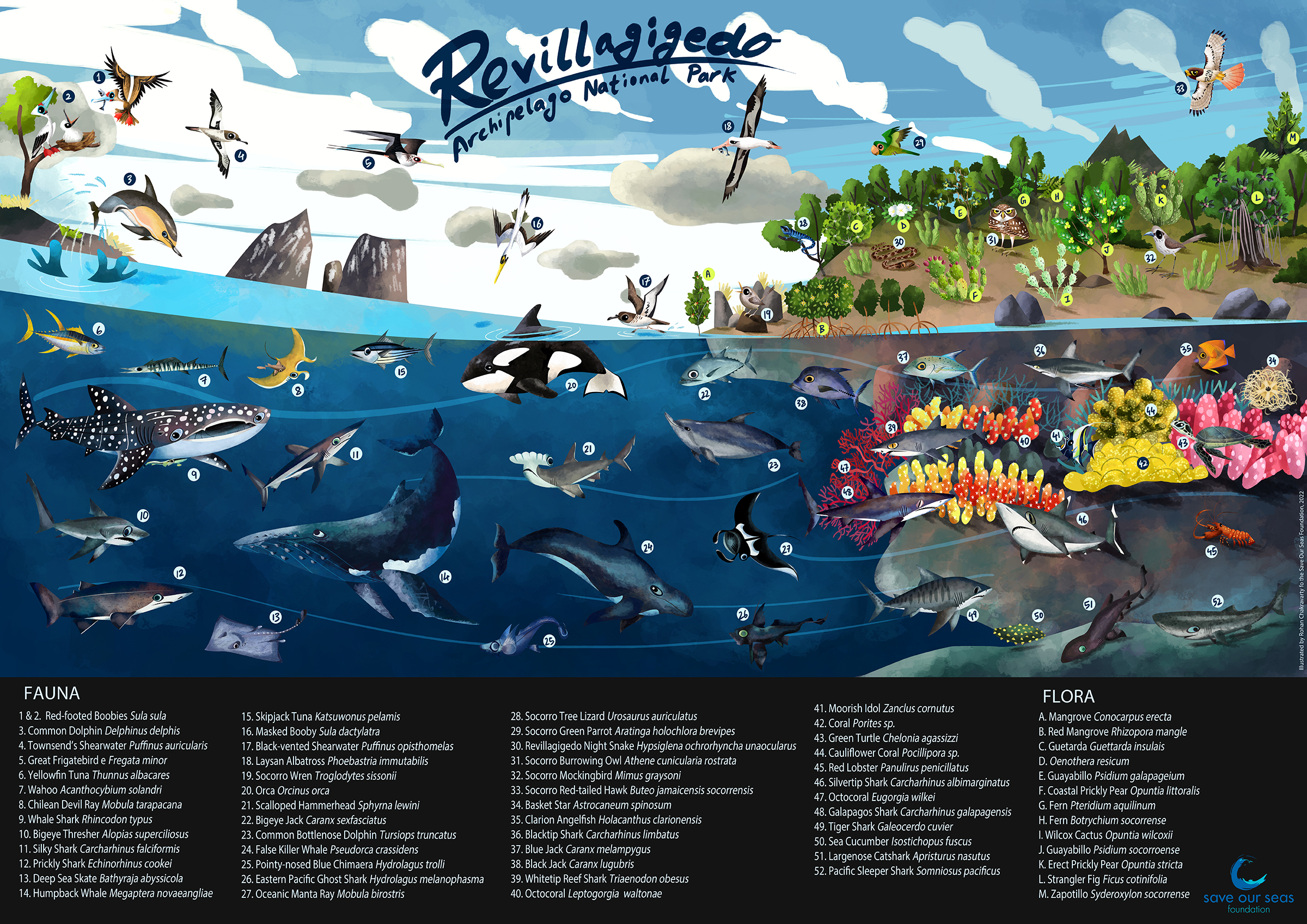
Revillagigedo Archipelago National Park


(Click on the images for a larger preview)

Revillagigedo, an archipelago of volcanic islands in Mexico, is a haven for island endemic wildlife and marine fauna, and North America's largest no-take marine protected area! Illustration for Save our Seas Foundation, which can be downloaded as a PDF from their website.

Thanks to SOSF for their continued association! Here are some close-up snippets from the illustration:


Sunday, 16 December 2018

Bioacoustics and Biodiversity Trends


Comic # 4 in my series with Current Conservation magazine 'Research in Translation', comics based on science papers, speaks about bioacoustics and their role in monitoring trends in biodiversity, based on a paper by Dr. Rachel Buxton. The bird in the comic is the Grey Catbird, one of the most vocal residents of the Rocky Mountains National Park in the USA, where the research is based.

More on the series here.

Thursday, 27 September 2018

Wild Canids of the World


If there is one wildlife family that's closest to mankind, it's the canids! Man's best friend, the dog itself, evolved from the largest wild canid, the Grey Wolf, and has another 35 of its wild cousins spread across the world except Antarctica. Canids are as diverse as they are adaptable, having evolved precise features to suit their lifestyles and habitats, such as the disproportionately large ears of the Fennec Fox to dissipate body heat in the desert, the dense white fur of the Arctic Fox that provides insulation against the Arctic winter, and the partially webbed feet of the Short-eared Zorro from the Amazon Basin that help the dog catch fish! While the Fennec Fox is the smallest wild canid in the world (and the Grey Wolf the largest), the Maned Wolf of South America holds the record for the tallest canid, owing to its abnormally long legs that help it navigate tall grass.

With Wildlife Week around the corner, Green Humour brings to you all the 36 wild canids of the world in one giant poster! Prints and a wide range of merchandise (tshirts, wall clocks, laptop skins, mugs and duvets) are available on my webstore here

A compilation of the genus Vulpes (see below) is also available as prints and merchandise here.


For orders within India, e-mail me on rohanchakcartoonist@gmail.com. The range of products for Indian orders is as follows-
A0 Posters (Matte surface, loose)- Rs. 3500 for the first print, 3000 for the second print onwards
A1 Posters (Matte surface, loose)- Rs. 3000 for the first print, 2500 for the second print onwards
A2 Posters (Matte surface, loose)- Rs. 1200 each
Mounted Posters (A3- Individual species and compilation)- Rs. 2000
Loose Posters (A3- Individual species and compilation)- Rs. 500 for the first copy and Rs. 200 for the second copy onwards
Fridge Magnets (65 x 65 mm, Printed in sets of 4)- Any 4 cat caricatures for Rs. 1200
Coasters (3.5" x 3.5", Printed in sets of 6)- Any 6 cat caricatures for Rs. 800
Coffee Mug (Compilation)- Rs. 850
Tshirts (individual species/compilation)- Rs. 1300 (White, Cotton, roundneck, sizes- S,M,L,XL)

(Note: the poster does not include sub-species of canids, such as the Indian Wolf, the Desert Fox etc. For the Canids of India list, visit http://www.greenhumour.com/2016/01/canids-of-india-and-striped-hyena.html)


Thursday, 17 May 2018

Tapirs of the World


Meet the tapirs- the cutest possible crosses between elephants and pigs, in this brand new poster!

Tapirs are large, herbivorous, forest-dwelling animals found in Central and South America, and South-East Asia. They are characterized by their prehensile nose trunks, that give them their exceptional sense of smell. Tapir piglets of all species sport bright spots and stripes to aid camouflage.

There are five extant species- four in Central and South America (The Baird's, Kabomani, South American and Mountain Tapirs) and one in South-East Asia (Malayan Tapir). All the five species are threatened by hunting and habitat loss throughout their range.The Kabomani Tapir was described in 2013, making it the first odd-toed ungulate discovered in a century!

Prints of the compilation are available on my webstore here.


Tuesday, 23 January 2018

Flamingos of the World


Know your flamingos with this brand new poster, illustrating the 6 flamingo species found in the world! Graceful, slender and outlandishly gorgeous, flamingos are spread across the world as two species in the Old World (Greater, Lesser) and four in the New (Andean, Chilean, American and James's). While the Lesser Flamingo is the most numerous species, the Andean Flamingo is the most threatened. Flamingos worldwide are threatened by habitat loss and hunting. 

Flamingo prints, tees and merchandise are now available on my webstore here. Pink never got this sexy!

(For orders within India, e-mail me on rohanchakcartoonist@gmail.com. The range of products for Indian orders is as follows-
A1 Posters (loose)- Rs. 3000 each
A2 Posters (loose)- Rs. 1200 each
Mounted Posters (A3- Individual species and compilation)- Rs. 2000
Loose Posters (A3- Individual species and compilation)- Rs. 500 for the first copy and Rs. 200 for the second copy onwards
Fridge Magnets (65 x 65 mm, Printed in sets of 4)- Any 4 whale caricatures for Rs. 1200
Coasters (3.5" x 3.5", Printed in sets of 6)- Any 6 whale caricatures for Rs. 800
Coffee Mug (Compilation)- Rs. 850 )

(Canvas for the mug and laptop skins)


Saturday, 2 December 2017

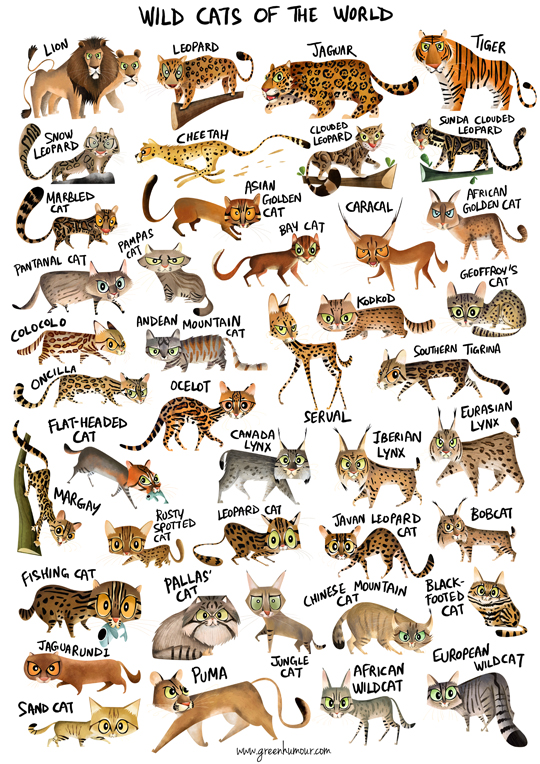
Wild Cats of the World


Cats- charismatic carnivores, fabulous felines, and the world's favourite animals! Wild species of cats occur throughout the world (except Australia and Antarctica), distributed across different ecosystems in 36-40 species. From the Snow Leopard of the Himalayas to the Flat-headed Cat of South-East Asia's marshes, wild cats occupy every imaginable habitat. Wild cats range in size from the 300 kg Tiger, to the 1.6 kg Rusty-spotted Cat! Wild cats are threatened by persecution, poaching and habitat loss throughout their ranges, with the Iberian Lynx, Flat-headed cat, Andean Mountain Cat and the Fishing Cat being the most endangered species.

Get all these 40 cuddly kitties home in this giant poster! Prints and a wide range of merchandise including t-shirts, mugs, laptop skins, wall clocks are now available on my webstore here.


Get the 201 Wild Cat calendar on Redbubble here.


For orders within India, e-mail me on rohanchakcartoonist@gmail.com. The range of products for Indian orders is as follows-
A0 Posters (Matte surface, loose)- Rs. 3500 for the first print, 3000 for the second print onwards
A1 Posters (Matte surface, loose)- Rs. 3000 for the first print, 2500 for the second print onwards
A2 Posters (Matte surface, loose)- Rs. 1200 each
Loose Posters (A3- Individual species and compilation)- Rs. 500 for the first copy and Rs. 200 for the second copy onwards
Coffee Mug (Compilation)- Rs. 850


Sunday, 2 April 2017

Otters of the World

Otters- one of the world's most adored group of mammals! No other carnivore blends mischief and  agility like otters do. Spread across the world as thirteen species, otters inhabit waters both temperate and tropical, inland and marine; and are important predators that check the populations of fish and help maintain the good health of aquatic ecosystems. Hunted indiscriminately for their fur, which is the finest for any animal on Earth, otters have faced a drastic decline the world over. Today, several otter species are grappling with hunting, habitat loss, and water pollution.

 Meet the thirteen species of otters here-

Eurasian Otter

The Eurasian Otter is the most widespread otter species. Found across Europe, Asia and Northern Africa, this animal prefers freshwater, but also occurs in coasts rarely. In India, the Eurasian Otter is found in the Himalayas and the Western Ghats. The species is classified as 'Near-threatened' on the IUCN Red List.

Smooth-coated Otter

The Smooth-coated Otter occurs in wetlands, swamps and river basins of India and South-East Asia. A very vocal and playful animal, the Smooth-Coated Otter can often be seen engaged in play with other members of its species. It is listed as 'Vulnerable' on IUCN's index.

Oriental Small-clawed Otter

The smallest otter in the world, the Oriental Small-clawed Otter is found in India (Western Ghats and the North-East), and South East Asia. As the name suggests, its claws do not extend beyond the fingers. This species too, is listed as 'Vulnerable'.

Hairy-nosed Otter

One of the rarest otter species, the Hairy-nosed Otter of South-East Asia is identified by the hairy vibrissae at the ends of its nose. The otter hunts fish and crustaceans along inland rivers. It is endangered because of habitat loss and hunting.

Spotted-Necked Otter

Native to Sub-Saharan Africa, the Spotted-necked Otter inhabits inland rivers and streams. It is identified by the white spotted patterns on the neck, with considerable variation existing among individuals.

African Clawless Otter

Also called the Cape Otter, the African Clawless Otter is the second-largest freshwater otter (after the Giant Otter). Its feet are clawless, with the exception of a few hindfeet. It is 'Near-threatened' on the IUCN index.

Congo Clawless Otter
The Congo Clawless Otter is a rare otter endemic to the Congo Basin in Central Africa. Although it is extremely similar to the Cape Clawless Otter (and has been recently split as a separate species from the latter), it can be identified by the pale guard hair on its forehead and nape, that give it a 'frosted' appearance, and also from the pale lining around the markings over the snout. Hunting and habitat destruction are its immediate threats.


North-American River Otter

Endemic to North America, the North American River Otter inhabits both freshwater and coastal habitats, where it hunts fish, frogs, mussels and clams. It is found across Canada and parts of the USA.

Neotropical Otter

The Neotropical Otter occurs in Central America, South America and Trinidad and has the widest range among New World otters. It lives along fast-flowing rivers in different kinds of habitats- forests, grasslands and the Pantanal. The Neotropical Otter is 'Near-threatened'.

Southern River Otter

Although this species is called a river otter, it inhabits both fresh and marine water. The Southern Rver Otter is found in South America in Chile and Argentina. The species requires dense vegetation along shorelines to thrive, and is endangered because of hunting and habitat loss.

Marine Otter

A rare and endangered otter, the Marine Otter of South America occurs in coastal Peru, Chile and Argentina. Its exclusivity to marine habitats makes it the world's smallest marine mammal! It is also the second-smallest otter, after the Oriental Small-clawed Otter. The Marine Otter is endangered.

Giant Otter

Found in the Amazon Basin, the Giant Otter is the largest freshwater otter species. Extremely social animals, Giant Otters live in large family groups headed by an alpha pair. The markings on their necks differ among individuals, and are used by group members to identify one another. Giant Otters are very vocal, and use a variety of vocalizations, threat and alarm calls to communicate. They are also an unusually fearless species, readily challenging larger predators like Jaguars and Caiman! Their fur is the shortest among otters, but highly valued as pelts. Owing to hunting and habitat loss, the Giant Otter is endangered today.


Sea Otter

Found in the coasts of the Northern Pacific Ocean, the Sea Otter is one of the most well-known and iconic otter species. Sea Otters are among the few mammals capable of using tools- they use rocks to crack the shells of molluscs! Sea Otters are a keystone species that feed on sea urchins and help maintain kelp forest ecosystems. They are also known to be very dedicated mothers. Despite inhabiting the cold seas of the North Pacific, Sea Otters lack blubber and rely on their dense fur for insulation. Sea Otter fur is the finest in the animal kingdom, and has unfortunately made them a soft target for the fur industry, landing them in the 'Endangered' category on IUCN's Red List.


The compilation, as well as individual illustrations are available as prints, apparel and a wide range of merchandise on my webstore here

For orders within India, e-mail me on rohanchakcartoonist@gmail.com. The range of products for Indian orders is as follows-
A2 Posters (loose)- Rs. 1200 each
Mounted Posters (A3- Individual species and compilation)- Rs. 2000
Loose Posters (A3- Individual species and compilation)- Rs. 500 for the first copy and Rs. 200 for the second copy onwards
Fridge Magnets (65 x 65 mm, Printed in sets of 4)- Any 4 otter caricatures for Rs. 1200
Coasters (3.5" x 3.5", Printed in sets of 6)- Any 6 otter caricatures for Rs. 800
Coffee Mug (Compilation)- Rs. 850
Personal Diary (Hard Cover, A5, 150 pages)- Rs. 800
Tshirts (any available species/compilation)- Rs. 1300 (White, Cotton, roundneck, sizes- S,M,L,XL)

Go on, and bring these furballs home!