Showing posts with label lions. Show all posts

Saturday, 17 September 2022

The Cheetah Comes to India


Amid much pomp and show, and Prime Minister Narendra Modi's birthday, African Cheetahs from Namibia will be flown in a specially decorated aircraft to India today, to be reintroduced to Kuno Wildlife Sanctuary in Madhya Pradesh, which was initially prepared to establish a second population of Asiatic Lions. Read all my cartoons on the issue here

Sunday, 21 August 2022

Big Cats Big Jokes 2022

I first drew a cartoon about a Bengal Tiger and an Asiatic Lion discussing cheetah reintroduction back in 2010, when the idea was first broached. Now that it is just around the corner, it was time for a re-hash.

From my column with The Hindu Sunday Magazine

Wednesday, 22 June 2022

The Wildlife Map of South Africa


Diamond and gold may well be South Africa's most valued reserves, but this beautiful country's most invaluable treasure is its wildlife! True to its title of 'Rainbow Nation', South Africa boasts of a biogeography as diverse and complex as its multicultural ethnicity: from the savanna forests of Kruger National Park at one end, home to the Big Five; to the unique Cape Floral Kingdom at the other extreme, home to some of the country's rarest endemics. The topographically diverse nation has been designed to harbour a staggering amount of biodiversity by a few crucial factors: oceanic currents from two oceans that meet at its southern tip, and the Great Escarpment that divides the country into the various biomes that we see on the map: the Karoo scrubs of the northwest, the Kalahari desert in the north, the fynbos coastal ecosystem of the southwest, mountain forests of the south, the Drakensberg highlands shared by SA and Lesotho in the east, and the bushveld and savanna forests of the northeast. 

The map brings together more than a hundred of the country's wild animals in one massive illustration, with a special focus on endemic species. Prints are available on my webstore here, shipped worldwide. For orders within India visit my Indian webstore.

(A big thanks to friends and mentors who have hosted me in South Africa: Swati Thiyagarajan and Craig Foster of Seachange with whom I am working on a very exciting illustrated compilation; and Karishma Pais and Brajesh Bajpai!)

Click on the images below for some close-up snippets:


Monday, 20 June 2022

Tanzania Maasai Eviction

On Tanzania's forceful eviction of the Maasai people from their ancestral lands for the creation of a game reserve for the UAE royal family, from my column with The Hindu Sunday Magazine.

Sunday, 16 January 2022

Cheetah Introduction and the Asiatic Lion

As India prepares to introduce African Cheetahs to Kuno Wildlife Sanctuary, Nature TV News speaks to the dumped ex, the Asiatic Lion. Comic from my column with The Hindu Weekend.

Sunday, 20 December 2020

Crackdown by Governments on Artists


The crackdown of creative freedom of artists by governments is like triggering an evolutionary arms race. Comic from my column with The Hindu Sunday Magazine.

Sunday, 3 February 2019

Sunday, 8 July 2018

Asiatic Lions in Gujarat

The story of Asiatic Lions in Gujarat began as one of the greatest conservation success stories in the world, when a tiny population on the brink of extinction revived and started to flourish. But  now, the pride of Gujarat faces several new threats.

From my column with Mid-day today.

Saturday, 2 December 2017

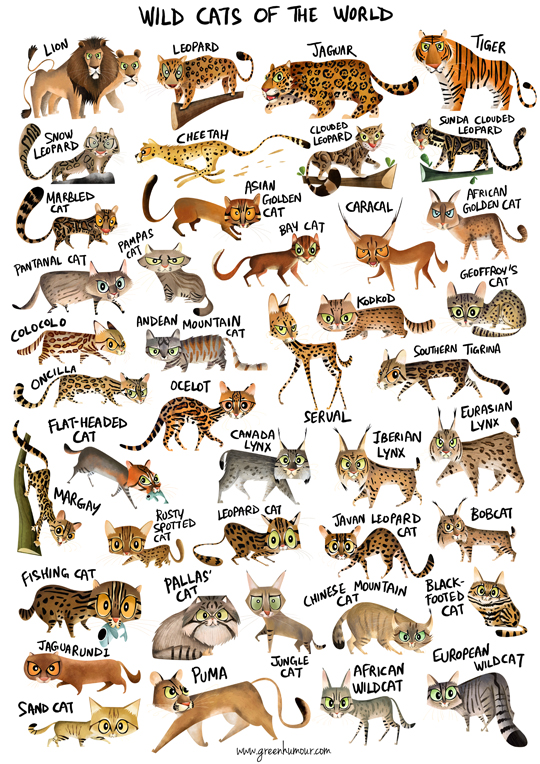
Wild Cats of the World


Cats- charismatic carnivores, fabulous felines, and the world's favourite animals! Wild species of cats occur throughout the world (except Australia and Antarctica), distributed across different ecosystems in 36-40 species. From the Snow Leopard of the Himalayas to the Flat-headed Cat of South-East Asia's marshes, wild cats occupy every imaginable habitat. Wild cats range in size from the 300 kg Tiger, to the 1.6 kg Rusty-spotted Cat! Wild cats are threatened by persecution, poaching and habitat loss throughout their ranges, with the Iberian Lynx, Flat-headed cat, Andean Mountain Cat and the Fishing Cat being the most endangered species.

Get all these 40 cuddly kitties home in this giant poster! Prints and a wide range of merchandise including t-shirts, mugs, laptop skins, wall clocks are now available on my webstore here.


Get the 201 Wild Cat calendar on Redbubble here.


For orders within India, e-mail me on rohanchakcartoonist@gmail.com. The range of products for Indian orders is as follows-
A0 Posters (Matte surface, loose)- Rs. 3500 for the first print, 3000 for the second print onwards
A1 Posters (Matte surface, loose)- Rs. 3000 for the first print, 2500 for the second print onwards
A2 Posters (Matte surface, loose)- Rs. 1200 each
Loose Posters (A3- Individual species and compilation)- Rs. 500 for the first copy and Rs. 200 for the second copy onwards
Coffee Mug (Compilation)- Rs. 850


Wednesday, 4 May 2016

An Illustrated Timeline of the Bombay Natural History Society

(Image copyright- Bombay Natural History Society. Click for a larger view)

In one of the most exciting projects I got to work on recently, I illustrated a timeline spanning 133 years of one of India's prime wildlife organizations- the Bombay Natural History Society. In the illustration, William the Hornbill, who was the BNHS' resident bird and mascot, takes you through some of BNHS' major achievements and landmarks since its year of foundation (1883) in British India, until the present. I also had the pleasure of reading about and drawing some of the most eminent naturalists in India's history, both English and Indian, including EH Aitkien, Col. FW Wall, Dr. Salim Ali, WS Millard (who introduced Dr. Salim Ali to ornithology), SH Prater (Author of The Book of Indian Mammals), Dillon Ripley (who co-authored 'The Handbook of the Birds of India and Pakistan' with Dr. Salim Ali), Humayun Abdulali, JC Daniel, Zafar Futehally, Dr. Asad Rahmani, Isaac Kehimkar, Dr. Vibhu Prakash and marine biologist Dr. Deepak Apte who is the current director of the BNHS. Working on the project also gave me a chance to spend some time at the BNHS office and taxidermy museum in Fort, Mumbai; which is a Mecca for wildlife enthusiasts in India. 

The massive illustration has been published alongside BNHS' latest portfolio. A big thanks to Dr. Apte and the BNHS team for choosing me for this!

Thursday, 30 July 2015

Lions and Trophy Hunting


The gory killing of Zimbabwe's iconic 'Cecil', an African Lion, by an American (of course!) dentist, has caused international furore over trophy hunting. While the debate continues, I can only wish that lions could somehow turn the tables on trophy hunters every now and then.

The cartoon appears on my Gocomics page today.

Thursday, 8 January 2015

Monday, 13 October 2014

Wild Cats of India

Which is the country with the highest wild cat diversity? That’s right- India. Fifteen of the forty cat species that comprise the family Felidae, are found in India, with the greatest diversity within India occurring in the north-eastern states. India is also home to both the largest wild cat (the Tiger) and the smallest (the Rusty Spotted Cat). (The Cheetah used to roam the plains of India until it was extirpated in the twentieth century.) Here’s a caricatured conglomeration of India’s wild cats: 5 charismatic big cats, 10 enigmatic small cats, one big poster!

                         
Bengal Tiger-
Our national animal and one of the most alluring species on the planet, the Bengal Tiger is an animal with which India is associated and identified with the most. Best seen in the jungles of Cenrtal India, tigers have not only boosted tourism in the region but have also driven conservation. Poaching, habitat loss and fragmentation along with several other problems are causing a steady decline in the tigers’ numbers.

Asiatic Lion-
The Asiatic Lion is a lion sub-species that exists only in Gir in Gujarat, where 400 of these majestic beasts live. Their small population is threatened by inbreeding, disease and conflict with humans. The male sports a scanty mane unlike the dense hair of its African cousin. The pride size is also significantly smaller than those of African lions. 


Leopard-
Its extreme adaptability, opportunistic behaviour and stealth make the leopard the most successful of the big cats. The leopard possesses an exceptional climbing prowess and is even able to carry heavy prey up a tree. It is poached heavily for its skin and parts and is facing a grave threat from habitat loss and man-animal conflict.


Snow Leopard-
The glorious Snow Leopard is a holder of many world records. It is the highest living land predator and is the only big cat that cannot roar. It also has one of the longest tails in proportion to the body length, which is used for balance and for wrapping around the body like a blanket to keep warm. The snow leopard is a master of camouflage and stealth. It is threatened by habitat loss, poaching and conflicts with sheep herders.
Clouded Leopard-
This gorgeous cat is the smallest of the big cats and dwells in the Himalayan hill forests of the North-East. Poached heavily in the region, it is listed as Vulnerable by the IUCN. They are considered among the most talented climbers in the cat family and among the few that can climb down vertical trunks head first. 


Fishing Cat-
The Fishing cat is a resident of wetland habitats and is classified as endangered owing to habitat loss. They are good swimmers and are primarily nocturnal. Fish comprise their main prey but they may also eat rodents, amphibians and carrion.

Jungle Cat-
The Jungle Cat is India’s most common wild cat. It is active both during the day and the night and is an efficient hunter, thriving in a variety of habitats. It preys on a variety of rodents and birds, and has been reported to kill animals larger than itself, such as porcupines.

Desert Cat-
The Desert cat inhabits the arid regions of North-western India. The closest wild relative of the domestic tabby, it often interbreeds with domestic cats in its home range. Among Indian small cats, it is exploited the most for its fur, and poaching is a significant conservation threat that the species faces.


Eurasian Lynx-
The northern Himalayas form the southernmost part of the range of the Eurasian Lynx, which occurs throughout Eurasia. It can be distinguished easily from other small cats by the long ear tufts, which are thought to enhance hearing. Their furred paws act as snowshoes, aiding locomotion in the dense snow cover of the higher Himalayas.


Pallas’ Cat-
The Pallas’ Cat or Manul is a rather odd-looking but endearing cat, extremely shaggy in appearance. Its flat face sets it apart from its cousins. The thick, dense fur help it keep warm in the harsh conditions of Ladakh, the only region where it occurs in India. It hunts a variety of rodents and birds, often on mountain slopes.

Asian Golden Cat-
An extremely secretive felid, the Golden Cat to me is the most attractive of all cats in India. It resembles the Mountain Lion of the Americas in appearance, but is much smaller and has short black stripes on its face. Found in the hill forests of North-east India, it is an extremely rare animal to come across, and is often reported from camera trap images. It ranks as ‘Near-threatened’ on the IUCN Red List owing to poaching and habitat loss.

Rusty Spotted Cat-
The Rusty Spotted Cat is the smallest wild felid in the world, and is found through much of peninsular India. It is nocturnal in habit and extremely shy, and is hence not commonly encountered. The unmarked tail is an identification tip for this species. It is also known to be very tolerant of human presence, often inhabiting the fringes of human habitation around forests.


Marbled Cat-
This beautiful, elusive cat is another denizen of the hill forests of North-east India, where poaching and deforestation have led it to be classified as ‘Vulnerable’ by the IUCN. The Marbled Cat is an extremely agile climber, with its extraordinarily long tail serving as counterbalance. The thick, dark spots give it the appearance of a miniature Clouded Leopard.

Leopard Cat-
This miniature version of the leopard is not only similar to its larger cousin in being spotted, but also shares its adaptability. It is the second most common small cat after the Jungle Cat, and thrives in a variety of habitats. It is usually arboreal and hunts rodents and birds. Although listed as a ‘Least Concern’ species, it faces a significant threat from hunting and habitat loss.

Caracal-
The gorgeous caracal is one of the most sought-after small cats among cat aficionados. The arid equivalent of the lynx, it occurs in a wide range, from Africa through Central Asia to North-western India, where it is an extremely rare animal to encounter. The long ear tufts and the long legs give the caracal its characteristic feline grace. It feeds on a wide range of prey including desert rodents, birds and even small deer.

The poster is available in both mounted and loose forms. You can order posters of both the individual species and the entire compilation-


Also, there’s a whole range of collectibles that made waves at my exhibition held in Bangalore this September. You can order these by mailing me. Here’s the list of products available with the wild cat caricatures on them-


Mounted Posters (A3- Individual species and compilation)- Rs. 2000
A2 Posters (loose)- Rs. 1200 each
A3 Posters (loose- Individual species / compilation) - Rs. 500 for the first copy and Rs. 200 for the second copy onwards
Fridge Magnets (3" x 4", Printed in sets of 4)- Any 4 cats for Rs. 1200
Coasters (3.5" x 3.5", Printed in sets of 6)- Any 6 cats for Rs. 800
Coffee Mug (Big Cats of India)- Rs. 850
Coffee Mug (Small Cats of India)- Rs. 850

Go on, mail me your orders (rohanchakcartoonist@gmail.com) and turn your house into a wild cat sanctuary!

Coffee Mug- Big Cats of India

Coffee Mug- Small Cats of India

Fridge Magnets (Set of any 4)

Coasters (Set of any 6)

For orders outside of India, please click here to buy wild cat prints and goodies on my Redbubble store.

Wednesday, 20 November 2013

Lions and Trophy Hunting


TV shows and internet videos that link machismo and animal hunts are propagating a very wrong message, and more so by often linking these practices to conservation. African Lion populations have dwindled recently owing to disease and human disturbances, and trophy hunting is the last thing that is required. While many argue that funds for conservation depend on trophy hunting, it is absolutely unnecessary to portray and propagate this as a 'macho ' 'sport'. The recent shooting of a lion by Melissa Bachman, the host of 'Winchester Deadly Passion' has sparked off a conservation vs hunting debate. If you're against the trophy hunting practice, do sign the petition against Bachman here.

This cartoon appears in the newsletter of the International Society for Behavioral Ecology whcih you can read here.

Thursday, 23 May 2013

India says no to dolphinariums!


Keeping dolphins captive is widely considered a form of animal abuse, as well as a threat to the conservation of dolphins owing to capturing of wild populations. Dolphins in the wild swim hundreds of miles everyday, whereas for those confined to little pools in dolphinariums, movement is extremely restricted, resulting in repetitive and even aggressive behaviour and other adverse effects opn mental and general health. Please remember that health therapy from dolphins comes at the cost of their own health and well-being.

This declaration comes as a sigh of relief for dolphins and dolphin lovers in India- http://articles.timesofindia.indiatimes.com/2013-05-20/flora-fauna/39392366_1_dolphinariums-awbi-ministry. Congrats to the MoEF for making this decision. Give me five!
Creative Commons License
This work by Rohan Chakravarty is licensed under a Creative Commons Attribution-NonCommercial-NoDerivs 3.0 Unported License.

Friday, 21 December 2012

'Boomsday'?

Creative Commons License
With the increasing incidences of meteor showers, this is quite a possibility! In a country like India, where humans populate the land exponentially each day, tigers, lions and all other fauna are losing their natural habitat; urban habitations are clashing constantly with natural and pristine spaces resulting in man-animal conflicts and ugly face-offs, and it is always wildlife that is at the receiving end. Leopards have suffered the worst, being more adaptable of the big cats.

This work by Rohan Chakravarty is licensed under a Creative Commons Attribution-NonCommercial-NoDerivs 3.0 Unported License.

Wednesday, 4 July 2012

Cat Campaign


What would happen if the big cats were to do a campaign such as this? Habitat destruction, poaching, mining, hunting, dams, pollution, plastics, industrial waste, man-animal conflict, unsustainable tourism, over-grazing, loss of habitat to agriculture- the list just doesn't end.

Well, well...
Creative Commons License
This work by Rohan Chakravarty is licensed under a Creative Commons Attribution-NonCommercial-NoDerivs 3.0 Unported License.

Monday, 17 October 2011

And Again!


The more human populations continue to grow, and the more we keep on increasing the bounds of urbanized civilization, eating away pristine forests, the more cases of man-animal conflict we encounter. As if the threat from poaching is not enough, mines and dams continue to undermine crucial tiger habitats and roads continue to bisect tiger corridors, leading to frequent clashes, accidents and events whose aftermath is extremely ugly for the Indian national animal.
Creative Commons License
This work by Rohan Chakravarty is licensed under a Creative Commons Attribution-NonCommercial-NoDerivs 3.0 Unported License.

Sunday, 21 February 2010

Cat Compromise


As the Indian population continues to grow, the pressure increases on all three big cats. All three species have problems of their own, such as the threat from inbreeding and disease for the Asiatic Lions of Gir, poaching and habitat loss for the tiger, and man-animal conflict and poaching for the leopard. Development and conservation have to be planned simultaneously if these cats are to be given a chance of survival.
Creative Commons License
This work by Rohan Chakravarty is licensed under a Creative Commons Attribution-NonCommercial-NoDerivs 3.0 Unported License.

Friday, 19 February 2010

'Sea Lions'!


Asiatic Lions once roamed all of Asia Minor and even Eastern Europe. Today, Gir National park, Gujarat, is the only place in the world where they are found. Once numerous, their numbers had gone down to just 13 in India (this figure has been a subject of controversy), thanks to hunting by the royal families in the 18th and the 19th centuries. Although the species is safe from the royal guns today, it faces grave peril from inbreeding (owing to its limited range), habitat loss and conflicts with humans. A lot has been talked about the relocation of a part of the 400+ population of Gir National Park to Kuno wildlife sanctuary, Madhya Pradesh, but the campaign remains suspended as Gujarat does not want to lose its status as the only state with Asiatic Lions. This majestic animal still remains torn between conservation efforts and political conflicts.

Creative Commons License
This work by Rohan Chakravarty is licensed under a Creative Commons Attribution-NonCommercial-NoDerivs 3.0 Unported License.