Showing posts with label cetaceans. Show all posts

Thursday, 7 March 2024

Whale Hybridization


New studies have found that hybridization between two of the largest animals on earth- the Blue Whale and the Fin Whale, is far more common than previously thought. What's more, some of these hybrids have also found to be fertile, indicating the occurrence to be beneficial particularly for the endangered Blue Whale! 

Cartoon for Roundglass Sustain

Sunday, 10 September 2023

Iceland Resumes Whaling


Iceland resumes whaling after temporary ban, despite public outcry and worldwide condemnation. Cartoon from my column with The Hindu Sunday Magazine.

Friday, 1 September 2023

Marine Biologist Dance Parties


I’ve never really been to a marine biologists’ dance party, but I’m sure this is how those weirdos celebrate!

Listen to some soulful Humpback Whale music here as you read this piece from my column with Roundglass Sustain

Thursday, 25 May 2023

Sunday, 14 May 2023

Mother Orca Woes


Being a mom is no easy feat, especially when you're an Orca mom raising a son! Comic from my column with The Hindu Sunday Magazine. Happy Mothers' Day!

More on the quoted study here.

Thursday, 8 December 2022

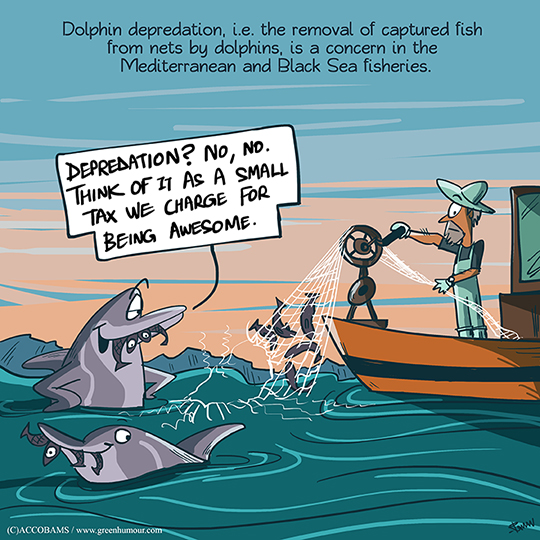
Cartoons on Dolphin Depredation


The issue of depredation, i.e. dolphins damaging fishing nets to take fish, has been a growing concern both for cetaceans and fishers in the Mediterranean and the Black Seas. I collaborated with ACCOBAMS (Agreement on Conservation of Cetaceans of Black and Mediterranean Seas) to bring out a set of 9 cartoons that break down the issue of dolphin depredation, and explain how better monitoring and implementation of scientific solutions can help control the problem. The cartoons have been translated to French, Italian, Spanish, Maltese and Arabic, and are being used in publications and multimedia, targeted at ACCOBAMS' partners and funding organizations. Another publication I am working on for ACCOBAMS, a comic + colouring book on the relationship between fishers and dolphins of the Mediterranean and Black Seas, will be out next month.

A big thanks to Julie Belmont from ACCOBAMS for the opportunity!

Sunday, 28 August 2022

Marine Noise and Dolphins


Marine noise is a growing threat worldwide, to the ecology of dolphins and other cetaceans that rely on sonar for communication, navigation and feeding. Comic from my column with The Hindu Sunday Magazine.

Monday, 21 June 2021

Pygmy Blue Whales in the Indian Ocean

Nuclear bomb detectors placed near Chagos Islands detected whale sounds, which when analysed by a group of scientists from the University of New South Whales, led to the discovery of a new population of Pygmy Blue Whales in the Indian Ocean! Comic from my column with Sunday Mid-Day.

Sunday, 17 May 2020

Killer Whale


The Killer Whale wasn't born a Killer Whale. Society made it one. 

I personally prefer the name Orca. Comic from my column with Sunday Mid-Day.

Thursday, 16 April 2020

Dolphins of the World


Meet the 44 dolphin species of the world in this brand new poster, from the largest, the Orca (Killer Whale) to the smallest, the Hector's Dolphin. Some of the most threatened dolphins are the ones found in freshwater ecosystems and estuaries, while many other species continue to decline. 

Dolphin prints are available as a wide range of prints, apparel and merchandise on my webstore here

(Note that the poster includes only species recognized by the IUCN. Sub-species like the Bolivian and Indus River Dolphins do not feature in this poster Printing and shipping within India are suspended at the moment and will resume after the COVID lockdown is lifted).

Wednesday, 11 March 2020

Great Bear Rainforest Habitat Illustration


One of the most unique landscapes on earth where temperate rainforests meet the sea, Great Bear Rainforest in British Columbia, Canada, is a mystical forest.  And this mystique transcends boundaries between land, water and air, and those between wildlife and native communities. The First Nations People of Canada that call the rainforest their home, have been fiercely safeguarding the forests from industrial logging and oil and gas companies. The rainforest is inhabited by many animals sacred to the First Nations People, such as the Spirit Bear (a rare sub-species of the American Black Bear in which some individuals are coloured white!), the Raven, the Bald Eagle, many species of Salmon, and of course, cetaceans like the Humpback and Fin Whales, and Orcas. As a result of rainforest meeting the sea, various interactions that are usually unheard of are witnessed here, such as enormous tracts of cedar and spruce meeting waters ruled by kelp forests, bears and wolves preying on spawning salmon, seals and sea otters bumping into wolverines and minks!

Other than its myriad flora and fauna, the illustration also depicts a First Nations couple in ethnic attire that celebrates the spirit of the animals they worship, veteran whale biologists Janie Wray and Hermann Meuter, who run the Cetacea Lab at Great Bear. Thanks to the Save Our Seas Foundation for commissioning the illustration.

Wednesday, 24 July 2019

The Wildlife Map of Maharashtra


Maharashtra's geography is as complex and intriguing as its animals. From the Western Ghats in the west home to a myriad endemic frogs, geckoes and birds, to the dry deciduous forests of the east home to a majority of India's tigers and the critically endangered Forest Olwet, Maharashtra has a staggering biodiversity. The state finds its state symbols in the Indian Giant Squirrel or Shekru (in Marathi), the Yellow-footed Green Pigeon (Hariyal in Marathi), the Blue Mormon butterfly, the Jarul flower and the Mango tree. Some of its true wonders are species that are found only in the Sahyadris such as the Amboli Bush Frog, the Koyna Toad, the Vigors' Sunbird and numerous varieties of hill flowers such as Karvi and the Satara Aponogeton. But possibly the biggest surprise of all is a mammal that's only found here and nowhere else in the world- the Kondana Rat, endemic to Pune's Sinhagadh!

A big thanks to WWF Maharashtra (Ms. Vaibhavi Shitut Amle, Ms. Caroline Pais, Ms. Farmeen Mistry) for commissioning the project and for giving me a chance to draw my home state! Thanks also to Dr. Parvish Pandya for reviewing the project and to marine biologist Abhishek Jamalabad for his valuable inputs. The map will soon be used in campaigns at schools associated with WWF India.


(click on the images for a larger view)


Monday, 19 February 2018

Dolphin Sightings


I'm sure some of you have had much better luck with watching dolphins in the wild than I have! The comic appears in my column with Roundglass Samsara.

Sunday, 24 September 2017

Why the Dolphin Smiles


Earlier this month on a visit to Hong Kong over an assignment, I took a trip with WWF to the fishing village of Tai O. While the trip yielded my first dolphin sightings in the wild (the Chinese White Dolphin, a race of the Indo-Pacific Humpbacked Dolphin, for which the Pearl River Delta in Hong Kong is one of the last remaining strongholds); a very special moment for me, I also happened to witness a rather jolting sight- that of a dead infant.


Infant mortality for dolphins has been on the rise in the Pearl Delta, because of the rising level of pollutants in the water, that go on to accumulate in and contaminate the milk of dolphins nursing their pups. Seeing that smiling face on a dead body has been one of the most disturbing moments for me in nature. Being one of the world's busiest ports, Hong Kong's polluted waters are already largely devoid of natural marine resources, posing a critical threat to the population of Chinese White Dolphins. 

The situation for Indo-pacific Humpbacks in India is not any better, with boat traffic, pollution, over-fishing, and noise threatening their existence. The comic appears in my column with Mid-Day today. This one's for you, baby dolphin.


Sunday, 24 April 2016

Cetaceans of Sindhudurg


I illustrated a booklet, 'Cetaceans of Sindhudurg' last year for the Konkan Cetacean Research Team, which is out now. Thanks to the KCRT for working with me over this fun booklet that gives you all information in a nutshell about the diversity and life of Sindhudurg's whales, dolphins and porpoises. The booklet has also been translated into Marathi.