Showing posts with label ecological imbalance. Show all posts

Monday, 6 November 2023

Eco Anxiety as an Activist


Are you an environmental activist or a nature conservationist? What does eco-anxiety feel like to you, and how do you deal with it? Let me know in the comments (feel free to CAPS lock!)

Cartoon for DW Environment.

Friday, 4 August 2023

Big Bad Mines


Have you, as a human ever wondered?

(Turns out, there actually IS a children's book about mining that I didn't know about when I drew this cartoon: Nandita Da Cunha's 'Pedru and the Big Boom', about the ecological and social impacts of mining in Goa)

Cartoon from my column with Roundglass Sustain.

Tuesday, 28 April 2020

Draft EIA Notification 2020


Clearance Man is back, and this time he is more powerful than ever before! The draft EIA 2020 takes various steps to ensure that environmental violations by corporations and industries are legitimized, some of which are listed in this comic. The policy is being pushed during the lockdown period so as to minimize questioning and opposition.

Read the Draft EIA here. An article on the notification by Mongabay can be read here. You may also follow the Twitter account by environment lawyers Kritika Dinesh and Meenakshi Kapoor, called Redraft EIA 2020 (@ReDraftEIA2020) for simplified tweets that explain the environmental impacts of the various points of the policy. If you are convinced that the draft EIA should be withdrawn, you may voice your objection to the policy on Let India Breathe here, and on Jhatkaa here.

This comic has been as a purely voluntary effort and is exempted from any copyright contracts that most of my other comics are under with their respective publishers. In case you would like to use higher resolutions of the comic, email me on rohanchakcartoonist@gmail.com. 

My thanks to Krithika, Meenakshi and Sushant Bali for their inputs.

Thursday, 11 June 2015

Why are grasslands important?

A comic about the importance of grasslands that appeared in my fortnightly with The Hindu BLink earlier this month. I also released a print of it at my second solo exhibition in Hyderabad last week.

If you're wondering what the animals in the second frame are- they're the Great Indian Bustard, the Hispid Hare and the Pygmy Hog- all grassland dependent, critically endangered species.

Tuesday, 17 September 2013

Queensland's Flying Foxes

Flying Foxes are gorgeous, fruit-eating 'megabats'. In 2008, the Queensland government banned the inhumane shooting of flying foxes as a crop protection measure. However, in 2012, the decision was reversed and farmers now are allowed to shoot a permitted number of these bats in their orchards. The fact that these bats are an indispensable element of the ecosystem as pollinators and seed dispersers has been overlooked, so has the threatened status of two flying fox species- the Spectacled and the Grey-headed Flying Foxes. The methods of extermination employed have been proven to be cruel and ineffective, and the permits are often violated. Flying foxes are slow breeders and conservationists fear that if their numbers plummet, they may not be sustainable anymore. http://www.dontshootbats.com/ is campaigning for the protection of Queensland's flying foxes. Visit the site for more information about the issue.
Creative Commons License
This work by Rohan Chakravarty is licensed under a Creative Commons Attribution-NonCommercial-NoDerivs 3.0 Unported License.

Wednesday, 24 April 2013

What's leading California Condors to extinction?


The California Condor, North America's largest land bird is critically endangered. One of the many causes of this is lead poisoning. Condors feed on carrion, and often ingest lead particles from the carcasses of deer and other game shot with lead bullets. Conservationists and organizations are working towards implementing a ban on lead ammunition to remove this threat. Being extremely slow breeders, the condors are left without a chance to make their populations recover and there are just about 400 + condors in the wild today, making this species one of the world's rarest birds.

Creative Commons License
This work by Rohan Chakravarty is licensed under a Creative Commons Attribution-NonCommercial-NoDerivs 3.0 Unported License.

Saturday, 24 November 2012

Shelling the Arctic?

Creative Commons License
The good news- Shell delays its oil drilling activities in the Arctic for the year. The bad news- with the Obama Government approving the bulk of Shell's drilling permits, the company is sure to resume its plans. Looking at Shell's track record of environmental mishaps and broken promises, this will be the final nail in the Arctic coffin and campaigners must fight till the end to avert this crisis.
This work by Rohan Chakravarty is licensed under a Creative Commons Attribution-NonCommercial-NoDerivs 3.0 Unported License.

Friday, 10 February 2012

Atlas and Climate Change


Ever wondred how Atlas must be coping with climate change?!

BTW, You can now read some Green Humour cartoons in the latest issues of Current Conservation magazine http://www.currentconservation.org/ . The magazine has great content and coverage, and the design studio, Pencil Sauce has made it one of the best looking magazines on the theme, with extremely creative and exquisite illustrations.

Creative Commons License
This work by Rohan Chakravarty is licensed under a Creative Commons Attribution-NonCommercial-NoDerivs 3.0 Unported License.

Thursday, 13 October 2011

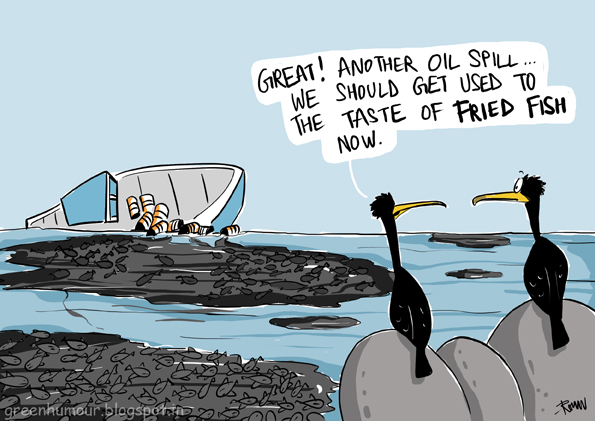
'Cormoranspiracy!'


Yet another major oil spill has occurred off the New Zealand coast, which has been recorded to be New Zealand's worst maritime disaster. This is another bad day for marine ecology. Read more about the news on http://www.mirror.co.uk/news/top-stories/2011/10/13/new-zealand-oil-spill-environmental-disaster-threatens-precious-coastline-115875-23484837/

The impact of oil spills on aquatic life is horrific. Oil spills hinder with the insulating properties of mammalian fur and the water-repelling capacity of the feathers of waterbirds. With these abilities destroyed, aquatic animals die of hypothermia. Shellfish and fish are not spared either. When fish come in contact with spilled oil, they experience inhibited growth, liver damage, damage of other vital organs, erosion of the fins and impaired reproduction. Mass deaths of fish in the event of an oil spill are not uncommon.
Creative Commons License
This work by Rohan Chakravarty is licensed under a Creative Commons Attribution-NonCommercial-NoDerivs 3.0 Unported License.

Tuesday, 6 September 2011

The Swindled One!


Electromagnetic radiation from mobile towers is thought to be a major contributing factor to the drastic and sudden declines in the populations of House Sparrows worldwide. Other factors include the fast replacement of traditional architecture with urbanized designs, pesticides, lack of nesting sites and food.

Thought I'd leave you guys with a cartoon on Sparrow conservation before I leave for 'The Lost Sparrow'. Enjoy the toon, and catch me at my exhibition at the Indian Habitat Centre, New Delhi on Thursday, September 8th. I will also be doing another sparrow cartoon as a demonstration for kids during the event. For more info about the event visit- http://www.gallerythreshold.com/the_lost_sparrow.html
Creative Commons License
This work by Rohan Chakravarty is licensed under a Creative Commons Attribution-NonCommercial-NoDerivs 3.0 Unported License.

Saturday, 3 September 2011

The Antarctic Salon


The polar regions of the earth are where the effects of global warming are most pronounced. Sea ice has been disintegrating constantly and at extremely alarming rates, the examples of which include the breaking away of the Larsen B ice shelf in Antarctica. The immediate effects of climate change are felt by the inhabitants of the poles such as polar bears, penguins. seals and whales. The penguins of Antarctica have very delicate and complicated life cycles, depending on seasonal variations and the availability of food. Any unprecedented change in this could mean death by starvation for their brood.

This is a re-rendition of old cartoon on global warming.


Creative Commons License
This work by Rohan Chakravarty is licensed under a Creative Commons Attribution-NonCommercial-NoDerivs 3.0 Unported License.

Friday, 5 August 2011

Shark 'Weak'!


Sharks are illegally hunted for food and tortured brutally, with their fins chopped off and their bodies thrown back into the ocean. Without its fins, the shark is unable to swim, let alone hunt, and drowns and starves to death. This brutal practice is prevalent in most oriental countries, and over the years, there have been several reports of finning being practised along Indian coasts.

It is the Shark Week but the food network is celebrating it with shark recipes! Raise your voice against these shameful proceedings; please sign the petition here at http://www.change.org/petitions/food-network-stop-featuring-shark-as-food?utm_source=action_alert&utm_medium=email&alert_id=wJVKGJawHJ_BTyaWairNU


Creative Commons License
This work by Rohan Chakravarty is licensed under a Creative Commons Attribution-NonCommercial-NoDerivs 3.0 Unported License.

Sunday, 13 March 2011

Snake's take


Naag Panchami is one of the most bizarre and ruthless festivals celebrated in India. Snakes are captured illegally by snake charmers, their fangs are hammered out of their jaws, to render them harmless (and practically disabled). This is not the end of the torture to these innocent reptiles- they are forced to perform in front of crowds and consume milk, which by no means is their natural diet.

Creative Commons License
This work is licensed under a Creative Commons Attribution-Noncommercial-No Derivative Works 2.5 India License.

Friday, 8 October 2010

Industrial Pollution


The most harmful sources of water pollution come from industries. Unplanned industrial growth, inefficient waste disposal and leaching of resources from the natural world have all contributed to the destruction of wetlands. Major environmental mishaps have occurred due to industrial pollution in the past and it is a growing concern for every country on the planet.

Creative Commons License
This work is licensed under a Creative Commons Attribution-Noncommercial-No Derivative Works 2.5 India License.

Sunday, 29 August 2010

Crying over spilt oil!

Oil spills have had a devastating impact on sea birds. On coming in contact with the oil, the feathers of the birds mat and separate, their waterproofing abilities are impaired, exposing the delicate inner bodies to the extremes in temperatures, and death often occurs by hypothermia. The birds often try to overcome the damage by preening, and unwittingly ingest the oil and this causes lethal damage to its internal organs.


Creative Commons License
This work is licensed under a Creative Commons Attribution-Noncommercial-No Derivative Works 2.5 India License.

Friday, 11 June 2010

Vulture table manners pre and post diclofenac


In the last two decades, there has been almost a 90% decline in the vulture populations of the sub continent. Several species that were once abundant such as the Gyps vultures are now nearing extinction. The culprit for this has been identified as Diclofenac Sodium, an anti-inflammatory drug that is used to treat ailments in cattle. When vultures consume carcasses of cattle treated with diclofenac, it causes poisoning, gout, kidney failure and death. Meloxicam has been made available as an alternative after the banning of diclofenac, but since the drug is expensive, diclofenac is still being used illegally.

Here's another one on the Diclofenac debacle.

Creative Commons License
This work is licensed under a Creative Commons Attribution-Noncommercial-No Derivative Works 2.5 India License.

Thursday, 10 June 2010

Desperate Measures-2


A vulture using a lab rat to check if the carcass contains diclofenac :)

Diclofenac is an anti-inflammatory drug used to treat cattle (also used as NSAID for humans as Diclofenac sodium). This drug has been responsible for mass deaths of Gyps vultures throughout south Asia. Vultures that feed on cattle carcasses containing Diclofenac (also Ketoprofen) suffer from gout and subsequent kidney failure. From 1993 to 2003, Diclofenace wiped out vulture populations by almost 99 percent, endangering several species that were earlier our most common vultures such as the White-backed and the Long-billed Vultures. Veterinary Diclofenac is now banned, and an alternative to it, Meloxicam has been made available, but Diclofenac is still being used illegally as it is cheaper than its substitute, and the threat to our vultures' existence still persists.

Creative Commons License
This work is licensed under a Creative Commons Attribution-Noncommercial-No Derivative Works 2.5 India License.

Saturday, 20 March 2010

Sparrow conservation cartoons


The decline in sparrow populations worldwide has been so drastic that even those who are most unobservant of the natural world, are feeling the difference. The little House Sparrow, our commonest and most familiar bird, is having a tough time battling with the following problems-
1. Microwave pollution- Our ever-increasing dependence on mobile phones has given way to the multiplication of mobile towers. Microwaves released from these towers are as injurious to the health of a sparrow as x-rays are to ours.
2. Lack of food- sparrows are commensals of man and are finding it difficult to adapt to our changing lifestyles. Traditional granaries are fats being replaced by malls, supermarkets. pre-cleaned and packaged grains, flour etc are now preferred. These are inaccessible to sparrows, who depend a lot on us humans for their existence.
3. Lack of nesting sites- modern architecture denies nesting opportunities to sparrows. Glass and aluminium composites have taken over, which offer no place for the sparrows to nest. Also, these new buildings hardly ever have gardens, and even if they do, they consist of ornamental plants which are of no ecologic value and often pose a threat to ecological balance.
4. Advances in agriculture and the use of pesticides
5. The introduction of unleaded petrol- the combustion of which produces methyl nitrate, which is toxic for insects. The diet of sparrow hatchlings comprises almost entirely of insects.

What you and I can do to help our winged friends-
It isn’t a tough task at all for every household to take care of one pair of sparrows each. All we need to do is keep water (preferrably in earthen vessels) and a handful of grains at places where the sparrows prefer to perch. For those who want to do more- just buy a bird box and hang it up at a place that is well out of the reach of dogs and cats and is preferrably a little cooler than the surroundings. I don’t think these tiny jewels are asking for a lot of effort from us at all. These small measures will really help increase their numbers.

For more information please visit- http://www.natureforever.org/decline.html
More cartoons on sparrow conservation on- http://www.greenhumour.com/search/label/sparrow%20conservation

Creative Commons License
This work by Rohan Chakravarty is licensed under a Creative Commons Attribution-NonCommercial-NoDerivs 3.0 Unported License.

Monday, 15 June 2009

Disrupted 'Pisce'!

Over-fishing has a disastrous impact on not just fish populations but all of marine life. There are reports of unsustainable fishing practices from all around the world as a result of which several species of fish including sharks are either nearing extinction or have died out already. Another danger comes from fishing nets that are killing turtles and dolphins, and collisions with boats are resulting in injuries to Dugongs and Manatees that are even fatal at times. In 2003, a report estimated that over-fishing has reduced the populations of commercial fish to just 10% of their pre-industrial population. Several measures need to be implemented urgently including aggressive fisheries management, the informed use of aquaculture; and laws governing catches need to be enforced effectively.


Creative Commons License
This work by Rohan Chakravarty is licensed under a Creative Commons Attribution-NonCommercial-NoDerivs 3.0 Unported License.