Showing posts with label wildlife. Show all posts

Monday, 3 August 2026

The Biodiversity Map of Delhi


(click on the image for a larger view)


It is easy to dismiss Delhi as the world's most polluted capital. But Delhi's choking rivers, stifled city forests, disappearing ridges and wetlands are still home to a stunning array of biodiversity. Migratory birds thronging on the banks of the Yamuna, bats flying out of its famed monuments, Nilgai bumping into joggers in city parks like Jahanpana Forest, and leopards, jackals and hyenas scrambling for refuge in the remaining vestiges of the Aravalli ridges are still occurrences in a city characterised by unplanned suburban expansion and an ever-growing human population. Delhi's proximity to India's oldest mountain range, the Aravallis, blesses the national capital with a diversity in vegetation like no other, with ridge specialties like the Dhok, Pilkhan and varius hill shrubs rubbing shoulders with Red Silk Cotton lining the capital's avenues. Endangered birds like the Egyptian Vulture make Delhi's busy highways its home, and Greater Flamingos, Pallid Scops Owls and migratory raptors still make its wetlands their winter home. 

In a city that withstands ecological annihilation from unmitigated development every week, wildlife fights for survival and space alongside Delhi's citizens. I hope that this map of the biodiversity of the capital will play a part in giving prominence to aspects of Delhi that the real estate industry would prefer to render invisible to the city's residents.

A huge thanks to Ms. Monalisa Sen of ICLEI South Asia for commissioning the illustration! The illustration is a freely downloadable resource available on ICLEI's website. 

Special thanks to my friend, wildlife conservationist and author Neha Sinha for her breakout publication 'Wild Capital' which served as an indispensable resource in the process of creating this illustration. 

Some snippets from the map are below-


Tuesday, 17 February 2026

Jessami - an Illustrated Biodiversity Map


Last year in March, commissioned by Roundglass Sustain, I travelled to Jessami, a Naga village in the remote north-eastern corner of Manipur. Inhabited primarily by members of the Chakhesang tribe, Jessami's residents have historically hunted birds and other wildlife as means of sustenance. Now, the village and its residents are actively involved in the conservation of the region's birdlife and wildlife, with Manipur's State Bird the Hume's Pheasant being the cornerstone and the pride of the village.

This illustrated map details Jessami's rich biodiversity- to be used both as a handy tool for locals and guides, as well as collectibles and souvenirs for tourists and wildlife enthusiasts. The map's visual style and illustrated elements pay homage to weavers of the Chakhesang community, whose art is passed only in person intergenerationally, and created seldom with any monetary motive!

A big thanks to Neha Dara and Megha Moorthy of Roundglass Sustain for trusting me with this project, Weyepe Mekrisuh and Asset Weyzah for guiding me during my field visit and for sharing their immense knowledge of local history, topography and culture with me. Thanks also to Mr. Weyzah for opening the doors of his home to me, where Mrs. Weyzah generously taught me her family recipe of Eromba, and where his uncles and aunts gave me invaluable insights into the community's art and fabric.

I urge fellow birdwatchers, wildlife enthusiasts as well as those looking for enriching artistic and ethnographic experiences, to visit Jessami and support the Jessami Village Council's efforts to sustain the tourism models that they have instituted to safeguard the avifauna and the wildlife of the region, including the iconic Hume's Pheasant, an IUCN Vulnerable species. More information about Jessami can be accessed on this Roundglass Sustain article of which this map illustration is a part.


Wednesday, 6 March 2024

Nepal: Mountains, People, Biodiversity


(click on the image for a larger view)


Every mountaineer dreams of summiting the Himalayas where they are at their mightiest- Nepal. As an illustrator and an orophile, my dream of summiting Nepal's mountains was through drawing them, and this map of our beautiful neighbour's biodiversity, mountains and people, created for the International Mountain Museum at Pokhara, was the perfect opportunity! From the tallest peaks in the world to the most pristine grasslands, from creatures as large as the Wild Yak and the bone-cracking Lammergeiers, to the diminutive Hispid Hare and the Himalayan Newt, from intricate architectural marvels like the Darbar Square monuments to the rustic Mustang Caves, here is Nepal in all its glory.


Nepal's majesty, mystique and aura can never be justly captured in illustration, and certainly not contemporary illustration. So when this challenge was thrown at me, I was convinced that incorporating stylistic elements from its indigenous art form Paubha (the precursor to Himalayan Thangka) would be the only way of doing justice to a project of this nature. I must convey a huge thanks to Samuel Thomas for facilitating a visit to the veteran Nepalese Paubha artist Lok Chitrakar's art studio, where I received some very important quick tips and insights into not just the art form but also the mind of the Paubha artists who he trains. 


The map will soon be on display at the International Mountain Museum. If you happen to visit Pokhara, do pay the museum a visit!


Wednesday, 27 December 2023

New Species of 2023


Newly discovered species from 2023 congratulate India's biologists for all the discoveries and rediscoveries made this year! Let's hope that our biologists will BRB with new ground-breaking science in 2024! Comic for Roundglass Sustain.

Saturday, 16 December 2023

American Bird Nomenclature


A controversy is brewing in the world of ornithology and birdwatching, with the American Ornithological Society's proposal to rename birds with problematic eponyms, as many of these names celebrate colonizers and white supremacists. While many young birders support the decision, some old-timers oppose it. The Scott's Oriole and the Audubon's Shearwater have given their verdict. What's yours?

Cartoon for DW Environment.


Tuesday, 12 December 2023

Tadoba Andhari Tiger Reserve


(click on the image for a larger view)

In my first project for the forest department of my home state, Maharashtra, I travelled to Tadoba Andhari Tiger Reserve last year to create this illustrated biodiversity map of the park, where Gond culture and heritage meet some of the most iconic wildlife of Central India, making it a jewel of the heartland. The richness of Madia Gond heritage reflects in the unique stone pillars used for relaying announcements during royal processions, still preserved within the tiger reserve. Nowhere else has the intertwining of nature and humankind been iconified as distinctively as in Tadoba, where sculptures of tigers chained with the victims of human animal conflict are placed commonly in the peripheries of villages surrounding the park.

While Tadoba's teak, ain and baheda forests offer refuge to tigers, leopards, sloth bears, dholes, honey badgers, small cats and a variety of herbivores like the Gaur and Sambar, its lakes are home to mugger crocodiles and a healthy population of the near-threatened Grey-headed Fish Eagle, making the reserve an eco-tourism hotspot. I hope that the map illustration succeeds in sensitizing state authorities about the biodiversity that the park abounds with, and in serving as a reminder of all that is threatened by the expansion of mining operations and roadways in the region. The map will be on display and available as souvenirs at the park's museums and interpretation centres.

A huge thanks to Deputy Director (Core) Mr. Nandkishore Kale for giving me this opportunity, and to my Prajakta Hushangabadkar, a field biologist working in Tadoba, for guiding me through the project.

Here are some snippets from the map:


Saturday, 17 December 2022

What's at Stake at COP15


Green Humour debuted on DW News, Europe's leading news channel this week, with a comic on why the Biodiversity COP should matter to me and you. Read the piece on DW here

Friday, 16 December 2022

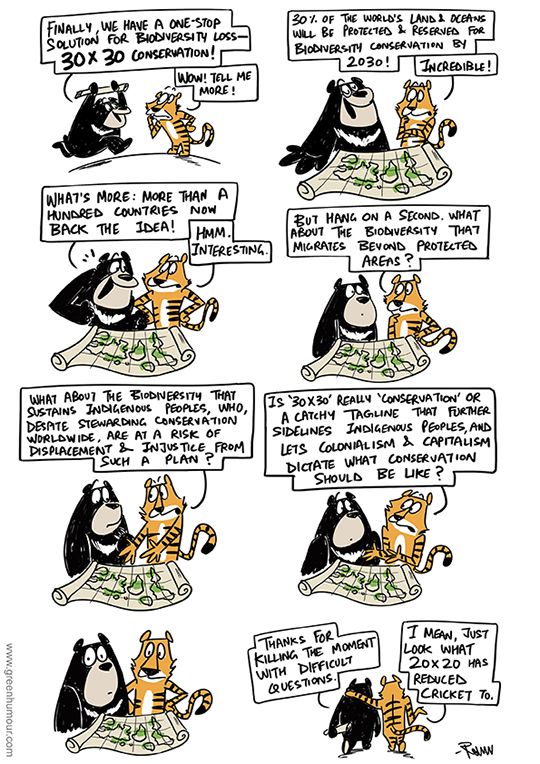
30 x 30 Conservation


A Black Bear and a Bengal Tiger discuss 30 x 30 conservation, which is proving to be one of the most heated international environmental debates right now, specially in the wake of COP15. Comic from my column with The Hindu Sunday Magazine


Saturday, 6 November 2021

Wildlife Map of Himachal Pradesh


(Click on the image for a larger view)

Did you know that the state of Himachal Pradesh is home to two biogeographical realms: the Palearctic and the Indomalayan? And this is what makes its biodiversity so special. Delighted to present my illustration for the Himachal Forest Department: The Wildlife Map of Himachal Pradesh. From the pine forests of the UNESCO World Heritage Site, the Great Himalayan National Park that harbours Himachal's majestic state bird, the Western Tragopan; to the cold deserts of Lahaul Spiti where Snow Leopards roam, the illustration focuses on species richness, diversity and distribution across this Himalayan state.

The map, released officially during the Wildlife Week in October, is up for display at various offices and interpretation centres in the state, and will soon be out as souvenirs. Please note that prints of this illustration are not for sale through my store, and the copyrights belong to the HP Forest Department.

Saturday, 13 March 2021

Birdwatching in Arunachal Pradesh


The dilemma of birdwatching in bird-rich regions. Arunachal Pradesh has consistently been yielding surprise after surprise, adding new species to the Indian checklist like the Yunnan Nuthatch and Red-flanked Bluetail among others, giving India even more reason to conserve its forests. Cartoon from my Roundglass Sustain column

Monday, 18 January 2021

Rewilding Gardens

Manicure Meena has rewilded her garden. Have you? Comic from my column with Sunday Mid-day.

Thursday, 26 November 2020

Urban Biodiversity Map of Nagpur - The Tiger Capital of the World


(Click on the images for a larger preview)

Being surrounded by tiger reserves, Nagpur has been popularly tagged the Tiger Capital of the World, owing to its record of having the most number of tigers within a 100 km radius for any city. But biodiversity within the city itself is exceptionally rich, and often neglected. Being the geographic centre of India, the city's lakes serve as spots for wintering, refueling and passage for several species of migratory waterfowl. Nagpur's scrub forests and dry deciduous landscape, which have been relatively undisturbed until recently, have ensured that the city peacefully coexists with mammals like leopards, pangolins, civets, wolves and even the rare Rusty Spotted Cat, existing well within its boundaries! Green pockets within the city offer refuge to a myriad insects, spiders and birds, hosting migrants all the way from Europe and Northern Asia, such as the Syke's Warbler and Rosy Starlings!

The map was commissioned by ICLEI South Asia and has just been released at the Nagpur Municipal Corporation office. Thanks to ICLEI for giving me the opportunity to draw my hometown. A special thanks to Tarique and Swati Sani, who have for years taken up the daunting task of documenting and curating the city's birdlife on their website Nagpurbirds.org, which is now merged with Bird Count India. A high resolution preview of the map is here, which will soon be up at some important public places in the city.

Sunday, 1 November 2020

No Shave November Indian Wildlife Challenge


The No Shave November Indian Wildlife challenge! Which one are you taking?
Comic from my column with Sunday Mid-Day.

Sunday, 11 August 2019

Be a Better Naturalist, Adopt a Stray


A comic starring me and my pups Srishti (the chocolate-vanilla-coloured) and Sakshi (the coffee-coloured) from my column with The Hindu's Sunday magazine. Adopt, don't shop!

Monday, 22 July 2019

Meet the Yellow throated Marten

Like all weasels, the Yellow-throated Marten is among the cutest-looking animals you'll ever see. And like all weasels, Yellow-throated Martens can shock you with their killing abilities! The comic appears in my column with RoundGlass Sustain, and is inspired by a recent report of a marten taking an adult Rhesus Macaque (an animal nearly twice its size) down in Corbett National Park.

Sunday, 3 March 2019

Environmental Costs of an Indo Pak War


This World Wildlife Day, a Hangul, Kashmir's state animal, briefs you about some of the environmental costs of an Indo-Pak border war. The comic appears in my column with Sunday Mid-Day.