Showing posts with label plover. Show all posts

Saturday, 11 November 2023

The Little Ringed Plover


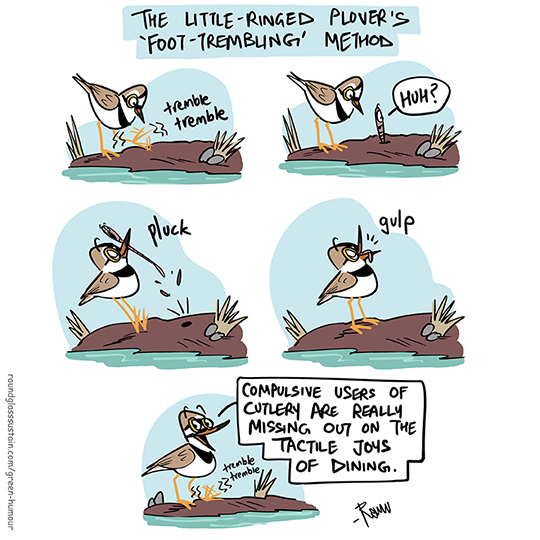
On a cold December morning in 2021 at the Vena Lake in my hometown Nagpur, I observed a cheerful Little Ringed Plover perform a strange dance: repeated wiggling of the foot followed by pecking the mud. It was clear that this was an improvised hunting strategy, but how exactly it was working, I was not sure. A quick search led me to this paper and I discovered that this behaviour is a little more than just an improvised hunting strategy: the bird’s trembling foot could either be driving out hidden worms and insects directly, or altering the thixotropic properties of wet sand, turning it into liquid, and making catching a juicy tidbit easier!

I may not love physics as much as this little genius does, but we certainly agree upon one thing: the tactile pleasures of dining are lost on compulsive users of cutlery!

Comic strip from my Roundglass Sustain column.


Saturday, 11 July 2020

Tips to save the Tuturuatu


Any conservationists / ornithologists / birders from New Zeaand here? I recently learned that the Tuturuatu or the Shore Plover is not just among the world's most endangered waders, but it also a very difficult bird to conserve, because it refuses to cooperate with conservationists! To save this species threatened from introduced predators and habitat loss, scientists have been trying to establish Tuturuatu populations on predator-free islands like Waikawa, Chatham, Mana. But in a recent conservation setback, an entire colony of Tuturuatus (not known to be long-distance flyers) disappeared from Mana, presumably flying off to a different island! Meanwhile, populations in Waikawa have been on the path to recovery, with the island now boasting of 24 breeding pairs.

Here are some tips to make Tuturuatus potentially cooperate with conservation measures better! Comic from my Gocomics page.

Thursday, 9 April 2020

Spring Migration Superstars- Comics for Birdlife International


Meet 7 Spring Migration Superstars- the European Bee-Eater, the Common Cuckoo, the Common Swift, the Barn Swallow, the Collared Sand Martin, the Common Ringed Plover and the White Stork. The comics have been created for Birdlife International's #SpringAlive campaign in which we introduce young birders to spring migrants. Thanks to Birdlife once again for collaborating with me.

Sunday, 28 October 2018

Top Ten Recommendations for Migratory Birds Visiting India


Are you a migratory bird visiting India and looking for recommendations? Well, look no further than Green Humour! (The birds in the comic are: European Bee-eater, Montagu's Harrier, Crab Plover, Rosy Starling, Indian Blue Robin, Grey Wagtail (with his guide Plum-headed Parakeet), Siberian Stonechat (with a performing Indian Peafowl), Cinereous Vulture, Steppe Eagle, Eurasian Griffon, Pied Cuckoo, Greater Flamingo, Marsh Sandpiper, Western Reef Egret and Pied Avocet. 

Comic from my column with Sunday Mid-day. Prints available on my webstore here. (For orders within India, e-mail me on rohanchakcartoonist@gmail.com)


Saturday, 4 February 2012

Did he do it?


Red-wattled Lapwings (Vanellus indicus) are ground-dwelling waders. They utter a "did-hee-doo-it" call that is extremely familiar with bird-watchers in India. They are beautiful and very noisy birds, more so when agitated. They make ground nests and are very protective of them, dive-bombing and distracting potential predators.

Some of Green Humour cartoons on birds are also up on the bird website Kolkatabirds.com. You can see them here- http://www.kolkatabirds.com/toons.htm

Read more about this member of the Plover family on http://en.wikipedia.org/wiki/Red-wattled_Lapwing
Creative Commons License
This work by Rohan Chakravarty is licensed under a Creative Commons Attribution-NonCommercial-NoDerivs 3.0 Unported License.

Sunday, 27 June 2010

Doctor Plover!


Symbiosis- a relationship in which both partners benefit from each other. One such example is that of the Nile Crocodile and the Egyptian Plover. The crocodile opens its mouth wide to let the plover in. the plover gets a free meal by cleaning the crocodile’s teeth clear of food debris, not getting eaten in return and not even paying the bills for its meal. Considering the fact that crocodiles love rotten, decaying meat, the plover's job doesn't seem to be one for the squeamish!
Creative Commons License
This work is licensed under a Creative Commons Attribution-Noncommercial-No Derivative Works 2.5 India License.