Sunday, 26 April 2015

The Bear Bile Rhyme

Farming of bears for bile is one of the most ruthless malpractices against wild animals, practised (not surprisingly) in China, Korea, Laos and Vietnam. The bears (usually Black bears or Moon Bears) are kept in 'crush cages' that are so small that the captive bear is rendered completely immobile. The process of extraction of bile itself is excruciating- an open wound or a fistula is created in the bear's gall, from which the bile drips out and is collected. Researchers have reported seeing bears moan and chew their own paws in pain during bile extraction. The wound is vulnerable to lethal infections, increasing their mortality rate. Even though science has proven bear bile to be of no medicinal use, its consumption continues as an ingredient of Traditional Chinese Medicine.

The comic appeared in my fortnightly with The Hindu's BLink.

Sunday, 19 April 2015

Vermin Who?


A cartoon about a law passed earlier this year, to declare problem animals as vermin, that appeared in my fortnightly with The Hindu's BLink last week. 

Friday, 17 April 2015

Large Herbivores of India- Caricatures

About time we had something mega, something massive, something magnanimous here- meet India's large herbivores!

The Asian/ Indian Elephant
Worshiped and revered in Indian mythology, the Indian Elephant is the country's favourite and the most iconic animal next to the tiger. The elephant is also India's National Heritage Animal. The elephant is listed as Endangered today owing to poaching, habitat loss and conflicts with humans. 


The Indian One-horned Rhinoceros
The Indian Rhinoceros is the pride of North-eastern India and defines the terai and the marshes along the foothills of the Himalayas that it inhabits. It differs from its African counterparts in having a single horn, and is second in size after the Asian Elephant, in all of our continent. It is listed as Vulnerable on the IUCN, and poaching continues to be the greatest threat to the survival of the rhino.


Gaur
The Gaur or the Indian Bison is the largest ox in the world. The massive animal is easily identified by the convex ridge between the horns on the forehead, and the neat, white socks on the legs. The Gaur is listed as Vulnerable owing to threats from hunting in countries such as Laos and Vietnam, and habitat loss.


Water Buffalo
One of the largest bovids in the world, a majority of the population of Asian Water Buffalo is found in the marshes of Assam. The animal is defined by its large, nearly semicircular horns. The Water Buffalo is endangered because of interbreeding with cattle, loss of its floodplain habitat, and hunting in countries such as Thailand, Myanmar and Cambodia.


Nilgai
The Nilgai (Hindi for Blue Bull) is the largest antelope in Asia and one of the most common ones as well. It inhabits dry deciduous and scrub forests. Sexual dimorphism is pronounced in this species; the males sporting bluish grey coats and a long, coarse hair shaped like a pennant on the throats, while the females are light brown.

Sambar
The Sambar is India's largest deer. Characterized by a uniformly dark brown coloured coat and large antlers on the male, the deer often emits a bark when threatened. Although the sambar is usually solitary, they may be seen in herds, and congregate at salt licks. The Sambar is listed as vulnerable because of poaching and habitat loss.

The posters (individual animals and the compilation) is available as prints in an A3 size, along with the regular range of goodies (fridge magnets, coffee mugs, diaries and coasters)-


Prices for the prints and merchandise are listed below-

A2 Posters (loose)- Rs. 1200 each
Mounted Posters (A3- Individual species and compilation)- Rs. 2000
Loose Posters (A3- Individual species and compilation)- Rs. 500 for the first copy and Rs. 200 for the second copy onwards
Fridge Magnets (65 x 65 mm, Printed in sets of 4)- Any 4 animal caricatures for Rs. 1200
Coasters (3.5" x 3.5", Printed in sets of 6)- All 6 animal caricatures for Rs. 800
Coffee Mug (Compilations)- Rs. 850
Personal Diary (Hard Cover, A5, 150 pages)- Any animal caricature in a vertical orientation on the cover- Rs. 800

The orders can be placed by e-mailing me on rohanchakcartoonist@gmail.com. Payments are accepted by NEFT and cheque. (Please note that I am shipping only within India at the moment)

Oh, and two points to you if you name the birds perched on the backs of the herbivores correctly!

Wednesday, 15 April 2015

Wider highways, narrower habitats


The widening of NH7, that passes right across prime tiger habitat in Central India is sure to spell doom for tigers and several other animals that inhabit these forests and the adjoining corridors. The widening has been sanctioned despite protest and disapproval from surveyors and scientists. A significant fraction of India's tiger population depends on the area in question, and the pressure on these habitats will only increase as the race for development grows irrepressible.

'NH7 Crusaders' is running a signature campaign to avert this decision here.

Thursday, 9 April 2015

When Clownfish get divorced


Clownfish and anemone display a remarkable symbiosis. While the anemone gives cover to the clownfish from predators, the clownfish rids the anemone of parasties. The anemone also picks nutrients from the clownfish's nitrogenous excrement. The activity of clownfish has also been found to cause better water circulation around the anemone.

The cartoon appeared on my Gocomics page last month.


Sunday, 5 April 2015

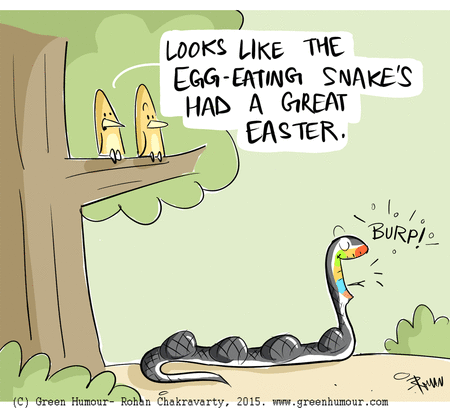
Happy Easter!

Egg-eating snakes have a unique adaptation- a vertebral bone extension called the hypapophysis that extends into the oesophagus and helps crack eggs, which the snake exclusively feeds on. The Indian egg-eating snake is critically endangered, having just been re-discovered recently.

The cartoon appeared on my Gocomics page this weekend. A Happy Easter to Green Humour readers!

Friday, 3 April 2015

Birds and window collisions


Millions of birds die each year from colliding with glass windows, most of them small song birds. While most of these injuries temporarily stun their victims, some result in internal injuries and subsequent death. Birds are unable to make out if the reflection in the window is an actual landscape or just a hard surface, and often crash into them while escaping predators. Several measures have been proposed and successfully implemented to avert this- such as relocating feeders, blocking the reflections with stickers or plastic wrap, attaching hanging objects in front of the windows or placing branches and twigs, and simply netting the windows.

The comic appeared in my fortnightly with The Hindu's BLink.